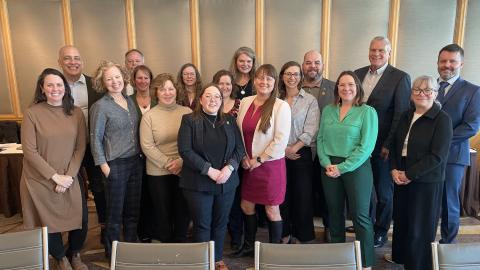
UBCM held its quarterly Executive and Committee meetings on February 26-27, 2026 in Richmond. In addition to these meetings, two workshops were held on February 25, 2026:
- A detailed presentation concerning the Cowichan Tribes v. Canada decision was delivered by Reece Harding, a partner with Young, Anderson where he outlined a rationale for UBCM to consider applying as an intervenor in an upcoming appeal of the decision.
- A discussion about UBCM governance was facilitated by Allan Neilson of Neilson Strategies and a plan to engage the UBCM membership on this topic was presented.
Director Vanessa Craig was welcomed to the Executive and is replacing Councillor Ben Geselbracht as the Association of Vancouver Island and Coastal Communities representative.
Key issues
Housing
Recent federal and provincial housing actions including the suspension of the Community Housing Fund, expansion of GST on professional services, and the launch of federal Build Canada Homes programs were reviewed. Private Member’s Bill M216 has prompted significant opposition due to risks related to public safety, liability, and loss of local authority, with over 500 submissions expressing concern. UBCM has formally highlighted major flaws in the Bill and requested an opportunity to present when the Committee resumes its review of the draft legislation.
Provincial legislation impacting local governments
The Executive were advised that recent provincial legislation affecting local governments covers areas such as prompt payment in construction, small‑scale multi‑unit housing, short‑term rentals, closed‑meeting rules, energy infrastructure, mental‑health amendments, and professional reliance in development approvals.
Mandatory Code of Conduct and Parental Leave for local elected officials
Legislation has been drafted for both initiatives and will likely be introduced during the spring legislative sessions.
Cowichan Tribes v. Canada
The Executive discussed the significant implications of the case – particularly the granting of Aboriginal title over fee‑simple lands – and considered the rationale, risks and communication needs related to UBCM intervening in the appeal. UBCM will be applying for intervenor status and a budget from the Operating Reserve was approved to support the application and related legal work.
2026-2027 Provincial Budget
The President and UBCM staff attended the budget briefing on February 17 and reported how certain provisions would impact local governments. It was noted that the budget makes modest investments in public safety, mental-Health care and FireSmart programs, but slows the housing strategy by pausing the Community Housing Fund and reallocating $1.4 billion in funding. It also introduces new taxation measures and expanded PST on professional services.
FireSmart Community Funding and Supports Program
The Executive was advised that the FireSmart Community Funding and Supports program has closed its open intake due to limited funds and moved to a competitive, closed process. The Province has provided $15 million to supplement the current intake but it is anticipated that all available funds will be expended once the intake is complete. This may result in many communities facing reduced FireSmart capacity and potentially losing local FireSmart Coordinator positions.
Committee reports
Presidents Committee
The Presidents Committee met three times during the quarter to discuss a range of issues such as funding challenges for the FireSmart program, progress on parental‑leave legislation for local elected officials, planning for the Advocacy Days survey, and proposed additions to presumptive cancer coverage for firefighters. Members reviewed updates on developing Emergency and Disaster Management Act regulations and directed staff to prepare a submission outlining key issues and local government concerns.
Other issues considered were the development of mental‑health supports for elected officials, results of the Advocacy Days survey, and priority policy areas such as emergency management, reconciliation and rural health‑care recruitment. Members received updates on operational and governance items such as extending the external auditor contract, future Convention planning, filling committee vacancies, establishing a housing committee, refining the Finance Standing Table’s Terms of Reference, and received updates on employee policies, financial statements and investments.
The Presidents and Indigenous Relations Committees met to review requests from both the Union of BC Indian Chiefs and the Province regarding proposed amendments to DRIPA. It was decided that UBCM should reaffirm its commitment to reconciliation through a principle‑based public statement to the Province and continue engaging members on reconciliation and DRIPA amendments.
Community Economic Development Committee
The Committee reviewed major provincial initiatives such as the Industrial Land Action Plan, forest policy updates, mineral tenure reform and the Look West strategy, noting challenges around industrial land servicing costs, contamination, and provided feedback to the Province on how local governments can be involved. They also considered referred resolutions 2025-NR95 and 2025-NR115, received updates on regional economic trusts and agricultural support requests.
Convention Committee
The Convention Committee received reports and provided direction on the 2026 Convention theme, the draft long program and the keynote speaker. The Committee also reviewed the function allocations for this year’s Convention. The financial statements for the 2025 Convention and the period ending December 31, 2025 were received by the Committee for information.
Community Safety Committee
Major public‑safety issues discussed included delays to Next Generation 911 implementation, cybersecurity coordination, policing pressures, liquor and cannabis policy, and the development of emergency‑management regulations. The Intersection Safety Camera Program review was considered including a letter advising the Minister of Public Safety and Solicitor General that UBCM does not support changes to the traffic fine revenue sharing framework without significant local government consultation. It was decided that three additional priorities would be advanced during 2026 Advocacy Days: implementing a 911 call‑answer levy on cellular devices, advancing local priorities pertaining to the the Police Act and public‑safety review, and improving emergency‑management support and disaster‑financial assistance.
Environment Committee
The Committee received a delegation from the BC Freshwater Security Coalition and were briefed on the Province’s increasingly stressed watersheds and emerging opportunities to enhance funding for watershed management initiatives. Members examined provincial work to streamline environmental assessments and natural resource permitting under Bill 15, noting potential impacts on local government planning and regulatory responsibilities, and expressed concern about the speed of these changes.
Health and Social Development Committee
A delegation was received from the BC Seniors Advocate and the group discussed a range of topics such as long‑term care bed shortages, ageism and home support. Committee members discussed the end of the provincial drug decriminalization pilot, health‑care workforce recruitment and retention, and upcoming meeting with Minister Osborne, while also identifying Advocacy Days priorities around Regional Hospital Districts, youth mental health, and childcare. Committee members expressed interest in meeting with the Ministers of Health, Education and Child Care, and Children and Family Development during Advocacy Days to advance these priority issues.
Indigenous Relations Committee
The Committee received and discussed reports on the implementation of UBCM’s MOU with the Ministry of Indigenous Relations and Reconciliation on local government engagement when the Province is negotiating agreements with First Nations, proposed resolution from the Aboriginal Housing Management Association (AHMA) on creating an Indigenous led multi sector alliance to address Indigenous housing and homelessness, and local government engagement on a provincial policy initiative that’s exploring providing property tax relief to First Nations who own fee simple property that is vacant or used for community/cultural purposes.
Resolutions Committee
The Committee reviewed its 2026 Terms of Reference, workplan timeline, updated Conference Rules and Procedures for Handling Resolutions, and communications plan, noting that the new four‑criteria system coming out of the 2025 Extraordinary Resolution (2025-ER1) will streamline the resolutions process and move certain items to an appendix. A communications plan related to 2025‑ER1 is being developed to provide additional information to the membership about how the resolutions process will be managed at the 2026 Convention.
Delegations
The Hon. Christine Boyle, Minister of Housing and Municipal Affairs and the Hon. Brittny Anderson, Minister of State for Local Governments and Rural Communities attended the meeting and the following issues were discussed/raised:
- The $1.4 billion claw back from the Community Housing Fund and whether the Minister will communicate how the Province will provide flexibility for local governments to meet affordable housing project targets.
- UBCM’s submission regarding the regional district legislative review and how ministry staff will work with UBCM staff as the evaluation of the recommendations continues.
- Concern with the prescriptive rather than collaborative approach proposed for the current engagement phase of the process to renew the Heritage Conservation Act.
- Appreciation for the collaboration between the Province and UBCM in developing legislation to mandate a minimum code of conduct and parental leave for local elected officials.
- Concern about the impact of Private Member Bill M216, the Professional Reliance Act on local government development processes and a recommendation that the Bill should be terminated at the Legislative Committee review stage.
The Executive received a delegation from the BC Assessment Authority to discuss the two-year process that led to a new approach for pipeline valuation and corresponding impacts on local government revenues. UBCM will write to the Minister of Finance expressing concern about the approach that is being taken with major industry valuation methodology reviews and will encourage government to consider local governments as a key stakeholder in the consultation process.