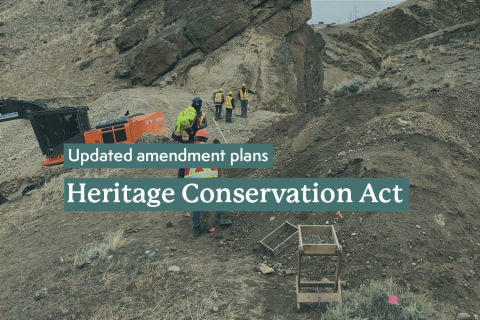
The Ministry of Forests has released a Technical Policy Paper on the evolution of proposed changes to the Heritage Conservation Act (HCA). This paper reflects the next phase of engagement on proposed changes to the HCA as the Province moves towards legislative amendments in fall 2026. Upon review of the paper, UBCM notes that the proposed changes incorporate local government, First Nations and other stakeholder feedback, and that several areas of concerns raised by UBCM members have been addressed. The Province intends to move forward with a request for legislation following a 30-day comment period on the technical policy paper. UBCM will be given an opportunity to review the proposed legislative changes following the paper’s comment period, and will determine if the final changes fully address member concerns.
A webinar is scheduled for this Thursday April 2, 9-10:30am, for UBCM members to hear from Ministry of Forests staff about updates to the proposed changes, and specifically how feedback from local governments has been incorporated. Webinar registration remains open.
Written comments on the Technical Policy Paper may be submitted to the provincial government via email until Thursday April 23, 2026.
Addressing local government concerns: Key changes in the Technical Policy Paper
UBCM made a submission to the Ministry of Forests in November 2025 that consolidated feedback from UBCM member local governments and First Nations regarding the proposed changes to the HCA. The submission indicated that the amendments under consideration by the Province posed a significant risk to increase the financial burden upon local governments and homeowners to comply. Respondents also identified concerns that the changes could delay private and public projects even further. UBCM members warned that if the Province moves too quickly at this stage it risks negative public reaction to the impact of the proposed changes on private property rights. Overall, local governments highlighted the lack of clarity around the roles, processes and the legislative and regulatory framework required to implement the proposed changes.
The technical paper seeks to address in part several of these concerns by removing the following proposed changes from provincial consideration:
Intangible Heritage – The paper proposes to not include references to “intangible heritage” in the HCA, citing concerns from local governments about potential ambiguity. Protections for sites of ceremonial, spiritual, or cultural significance to First Nations would continue to be available through existing agreement and designation mechanisms, supported by established review and consultation processes.
Heritage Management Zones – Heritage management zones (HMZs), that would recognize that archaeological or heritage values may extend beyond known or recorded sites, will not be included in the proposed legislative package. This reflects local government concerns about data accuracy, clarity of application, and public understanding of the Provincial Heritage Register. The Province proposes further analysis and public education initiatives, while continuing to enable Heritage Management Plans as a proactive planning tool.
Compliance and Enforcement – Compliance and enforcement (C&E) agreements with First Nations will not be included in the proposed legislative package, reflecting concerns raised by local governments about governance clarity, oversight, and consistency of enforcement. The Province proposes to continue supporting First Nations involvement in compliance and monitoring through existing tools and information‑sharing mechanisms, such as the Guardians programs.
Permitting & Consent Seeking – Proposed “consent‑seeking” language related to permitting decisions will be removed from the HCA, after creating confusion during engagement with local governments as to how it would be operationalized. The Province will continue to rely on existing processes to fulfill its constitutional duty to consult with First Nations on permitting decisions.
Records of Engagement – Records of engagement will not be a legislated requirement for HCA permit applications, reflecting concerns about added burden for proponents. Instead, maintaining a record of engagement will be promoted as a best practice, supported by future guidance materials.
The technical policy paper also made several points of clarification in line with local government concerns around agreements with First Nations and heritage information checks. Notably, Declaration Act s. 6 and 7 agreements will be enabled on Crown land, but with scope limited to certain provisions of the HCA and not include permitting decision. Operational agreements proposed for private land will require landowner agreement. Heritage information checks will be required only for building permits or property sales that involve ground disturbance.
UBCM has provided the following preliminary assessment of the technical paper’s proposed changes in relation to the local government concerns and recommendations raised in UBCM’s submission to the Province.
| Topic Area | Local Government Priorities that are Addressed | Local Government Priorities that are not Addressed |
|---|---|---|
| 1. Consultation and Process | • Draft legislation to be provided to UBCM for review | • Requests to pause legislative drafting • Requests to co‑develop materials • Requests to hold regional engagement sessions |
| 2. Resourcing and Capacity | • Funding for provincial and local government staff • Indigenous and local government training • Expansion of archaeological workforce • Addressing conflict‑of‑interest potential in contract awarding | |
| 3. Governance Clarity | • The Province retains oversight • Clarification on compliance and enforcement roles as well as heritage information checks • Heritage Management Plans is the tool to formalize shared decision making between local governments and First Nations | |
| 4. Permitting and Efficiency | • Permitting will be streamlined • Emergency exemptions enabled | • Clarity on how permitting processes will be streamlined and digitized |
| 5. Heritage Management Plans | • Clarification that Heritage Management Plans are agreements to be developed between parties, including First Nations, local governments, or industry groups, which could support integration with land‑use frameworks | • Financial support for local governments and First Nations to implement proposed changes • Updated heritage mapping |
| 6. Compliance and Enforcement | • Enables compliance and enforcement tools including violation tickets, administrative monetary penalties, and prohibition of trade in heritage objects • Strengthened duty to report and overall enhanced compliance and enforcement regime | • Establish standardized procedures, appeals and training • Avoid financial conflicts • Maintain provincial consistency • Apply regulations to federal and reserve lands |
| 7. Public Communication | • Public education, plain‑language resources and improved data transparency | |
| 8. Integration and Alignment | • Clarifies legal definitions and responsibilities to improve consistency and understanding across jurisdictions |